Source code
79 dangerous-code patterns across JavaScript, TypeScript, Python, Java, Go, C, C++, C#, Kotlin, Swift, PHP, Ruby and Rust. Each maps to a CWE and comes with a fix.
 oxAudit
GitHub
oxAudit finds vulnerabilities and leaked credentials in source code, dependencies, binaries and container images. It runs as a desktop workbench and a command line over one engine, so a finding in CI and a finding on your laptop are the same finding.
Install the command line Read the source
Open source under Apache-2.0. No telemetry. Latest release v0.2.7.
Edit the code, then scan it. Nothing you type leaves this page.
This is a seven-rule toy written for this page. oxAudit itself ships 79 source rules, 14 infrastructure rules and more than 40 secret rules.
79 dangerous-code patterns across JavaScript, TypeScript, Python, Java, Go, C, C++, C#, Kotlin, Swift, PHP, Ruby and Rust. Each maps to a CWE and comes with a fix.
More than 40 credential rules with entropy filtering and placeholder suppression. A history scan runs the same rules over every blob reachable from any Git ref.
Reads lockfiles for npm, Yarn, pnpm, Cargo, Go, pip, Poetry, Maven, Gradle, NuGet, Bundler, Composer and more, and checks every pinned package against OSV.
Finds vulnerable components inside compiled binaries, archives, packages and firmware images with its own scanner. No database to download first.
Opens saved Docker and OCI images, reads their dpkg, apk and rpm package databases, and matches them against the right distribution release.
14 misconfiguration rules for Dockerfiles, Terraform, Kubernetes manifests and GitHub Actions: unpinned images, public buckets, wildcard IAM, privileged containers.
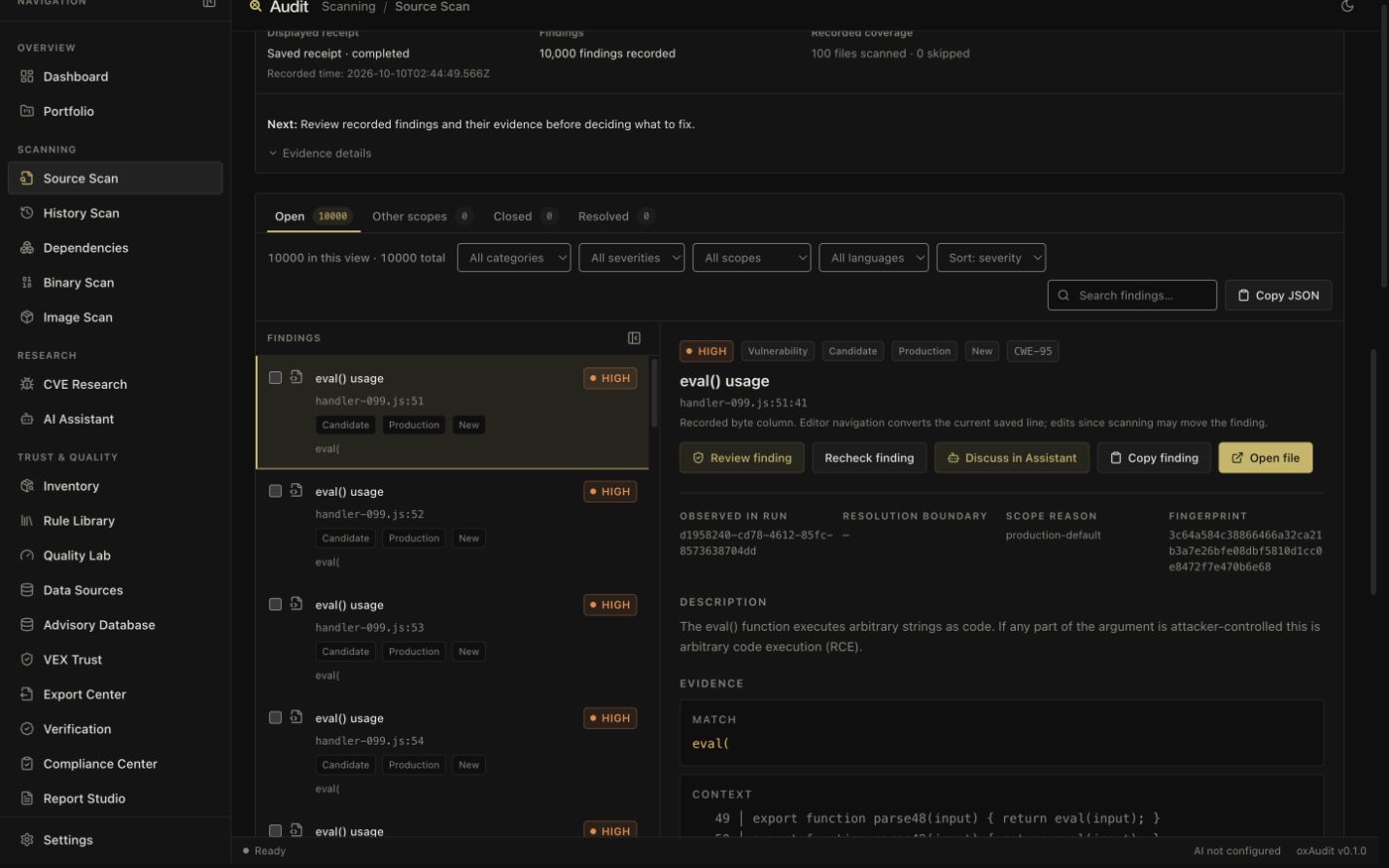
See what is in this project.
oxaudit-cli scan .Put it in a pipeline. Failing the build is opt-in.
oxaudit-cli scan . --format sarif --output oxaudit.sarif --fail-on highMeeting a backlog? Capture today once, on main.
oxaudit-cli scan . --format json --output baseline.jsonThen fail a pull request only on what it added.
oxaudit-cli scan . --baseline baseline.json --fail-on-new highBlock secrets before they are committed.
oxaudit-cli hook installReports export as oxAudit JSON, SARIF 2.1.0, CycloneDX 1.6, SPDX 2.3, OpenVEX and CycloneDX VEX. Under GitHub Actions the command line annotates the pull request on its own.
On macOS and Linux, the installer verifies the release checksum before it installs the command line.
curl -fsSL https://raw.githubusercontent.com/HenryCooper86/oxAudit/main/scripts/install.sh | sh| Command line | Linux x86_64 and aarch64, macOS universal, Windows x86_64 |
|---|---|
| Desktop app | Linux x86_64 packages. macOS and Windows build from source. |
| Container image | linux/amd64 and linux/arm64, with the command line and the browser workbench server |
| Editor | A VS Code extension that reports findings as diagnostics |